
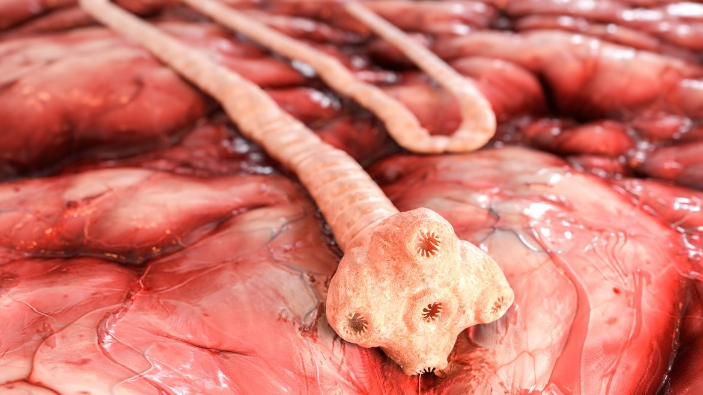
Taenia Tapeworm (Taenia spp.)

– Taenia is a genus of tapeworm common in dogs that have contact with raw meat. The main significance of Taenia in
dogs is its ability to infect livestock in larval form, leading to meat condemnation and
economic losses at the abattoir. As a canine parasite, Taenia multiceps is transmissible to humans.
Parasites: Taenia hydatigena, Taenia ovis, Taenia multiceps, Taenia pisiformis, Taenia serialis
– Common name: Taenia tapeworm
– Host: Dogs, foxes, wild canids
– Incubation period: 6–8 weeks
– Site of adult worms: small intestine
– Distribution: Worldwide
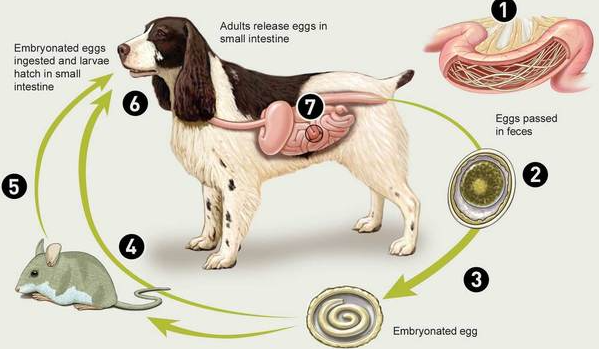
– Route of transmission: ingestion of encysted larval forms (cysticerci, coenurus) in the tissue
of an intermediate host (usually livestock)
– Transmission to humans: No, except for T. multiceps.
– Distribution
– Route of transmission:
Clinical signs
Taenia tapeworms rarely harm dogs and cats; most animals show no symptoms. Heavy
infections can cause nonspecific abdominal symptoms such as diarrhea or constipation and abdominal pain,
along with stunted growth and a pot-bellied appearance.
– Diagnosis

Proglottids (segments of the Taenia tapeworm) can actively crawl into the stool or around the genital
area of the animal (the most common sign owners observe). Fresh proglottids can expand in
water and be pressed flat between two glass slides to examine their morphology. The proglottids contain uterine pores that open
along the side (laterally). Gravid segments containing fertilized eggs contain typical Taeniid eggs.
Fecal flotation testing should not be used for diagnosis, since Taeniid eggs aren’t reliably shed into the stool.
The eggs of Taenia spp. cannot be distinguished from the eggs of Echinococcus.
– Transmission to humans
Taenia tapeworms rarely harm dogs and cats; most animals show no symptoms. Heavy
infections can cause nonspecific abdominal symptoms such as diarrhea or constipation and abdominal pain,
along with stunted growth and a pot-bellied appearance.
– Diagnosis
Proglottids (segments of the Taenia tapeworm) can actively crawl into the stool or around the genital
area of the animal (the most common sign owners observe). Fresh proglottids can expand in
water and be pressed flat between two glass slides to examine their morphology. The proglottids contain uterine pores that open
laterally (Figure 1). Gravid segments containing fertilized eggs contain typical Taeniid eggs (Figure 2).
Fecal flotation testing should not be used for diagnosis, since Taeniid eggs aren’t reliably shed into the stool.
The eggs of Taenia spp. cannot be distinguished from the eggs of Echinococcus.
 Diagnosis and treatment for pets (24/7)
 Pet accessories supplied
 Pet hotel
 Pet grooming
 Grooming training for students
 093 71 73 188
 135/31 Nguyễn Hữu Cảnh, Ward 22, Bình Thạnh, Ho Chi Minh City