
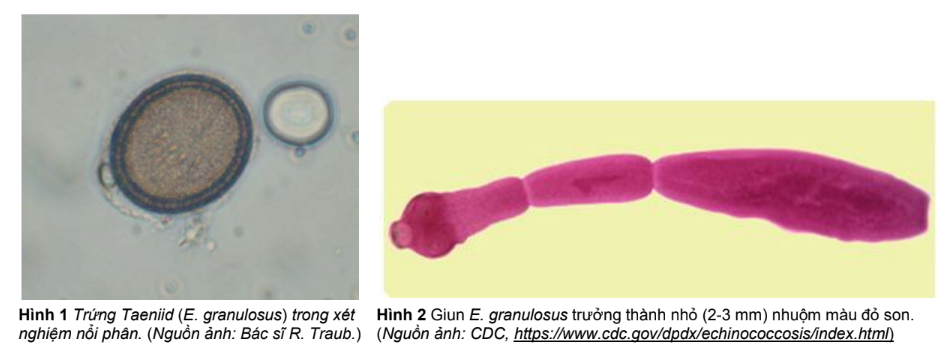
Hydatid Tapeworm (Echinococcus granulosus)
This tapeworm has no clinical significance in dogs; however, eggs shed by infected dogs will
infect humans and livestock, producing hydatid cysts in internal organs that lead to significant
impact on public health and the economy.
– Parasite: Echinococcus granulosus
– Common name: Hydatid tapeworm
– Host: Dogs
– Incubation period: 6–7 weeks
– Site of adult worms: small intestine
– Distribution: cooler areas of the subtropics
– Route of transmission: ingestion of fertile hydatid cysts within intermediate host tissue
– Transmission to humans: Yes
– Distribution
E. granulosus is distributed globally, but appears far more common in cooler areas
of the subtropics (e.g. northern India, southern Brazil), especially in rural regions where organ meat
is readily accessible to farm dogs and communities. This tapeworm has not been reported across much of
Southeast Asia, Central America, and the tropical Caribbean.
– Clinical signs
Dogs are not capable of showing clinical signs of infection.
– Diagnosis
Diagnosis needs to rely on the animal’s history — that is, its access to raw organ meat. Detecting eggs or proglottids
via a standard fecal flotation test is unreliable, since eggs are rarely shed into the stool. Even if eggs
are shed into the stool, they cannot be morphologically distinguished from the eggs of Taenia spp.
Deworming and checking for adult worms is not recommended due to the risk of transmission to humans
from accidentally ingesting E. granulosus eggs. Adult worms are very small, 3–9 mm long, with up to 3 proglottids.

– Treatment
Oral praziquantel at a dose of 5 mg/kg is the drug of choice.
– Control
Owners are advised not to feed dogs the organ meat of domestic or
wild intermediate hosts (e.g. livestock, horses, camels). In areas with high E. granulosus prevalence, dogs should be
treated with praziquantel every 6 weeks. Dog feces must be disposed of within a maximum of 48 hours
after treatment — it can be burned, buried deeply, or flushed down a toilet or septic system.
Intermediate hosts can also be targeted to control echinococcosis through
meat inspection at slaughter, as well as using a vaccine against the infection (EG95).
– Public health considerations
People become infected by ingesting eggs through direct contact with dogs (eggs sticking to a dog’s fur and becoming
infective as soon as they’re passed in feces) or by ingesting eggs in contaminated food or water. In humans,
infection may be asymptomatic or may present with organ dysfunction (e.g.
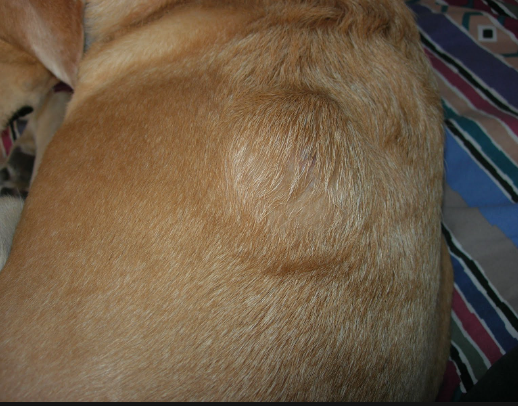
brain, lungs, heart, liver, etc.) as the hydatid cyst (Figure 3) puts pressure on adjacent organs. Typically,
hydatid disease has an incubation period spanning many years, since cysts take time to develop.
Cyst rupture or leakage can lead to fatal anaphylactic shock. Treatment is complex and typically requires
a combination of surgery and chemotherapy intervention.
BTM Pet Shop — Diagnosis and treatment for pets (24/7)
- ✂️ Pet grooming
- 🏨 Pet hotel
- 🎓 Grooming training for students
- 🛍️ Pet accessories supplied
- 🐕🐱 Dog & cat breeding services
- 💛 Helping pets find loving homes
- 📞 093 71 73 188
- 📍 135/31 Nguyễn Hữu Cảnh, Ward 22, Bình Thạnh, Ho Chi Minh City