
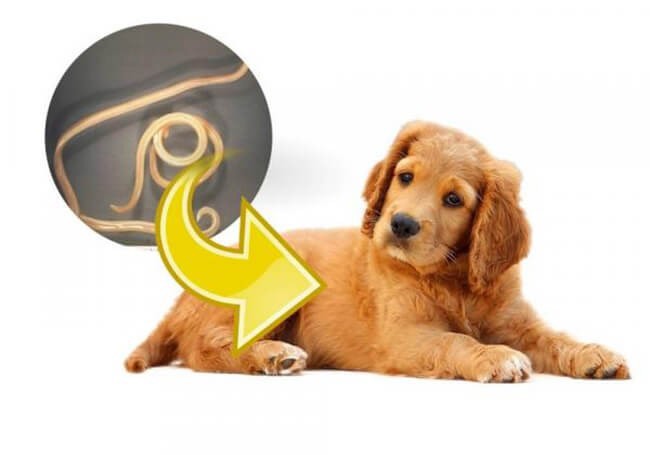
ROUNDWORMS
1. Characteristics of roundworm disease
– Roundworm disease is caused by two species of roundworm: Toxocara canis and Toxascaris leonina.
The worms live as parasites in the small intestine and stomach, and sometimes migrate to a dog’s muscles.
– Worm morphology:
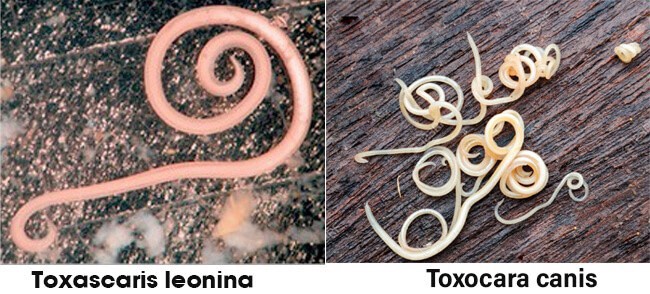
+ Toxocara canis: pale yellow worm, head slightly curved toward the belly; with a wide
cervical wing, a small stomach between the esophagus and intestine. Males are 5–10 cm long, with a
slightly blunt, curved tail bearing a caudal wing and a pair of equally long spicules. Females are
9–18 cm long, with a straight tail. The eggs are somewhat round, with a pitted, honeycomb-like shell,
yellow in color, sized 0.08–0.085 x 0.064–0.072 mm.
+ Toxascaris leonina: pale yellow worm, with a very narrow cervical wing that curves slightly toward the
back. Males are 4–6 cm long, with a pointed (not blunt) tail unlike T. canis, no caudal
wing, and a pair of equally long spicules (1.2–1.5 mm). Females are 6.5–10 cm long.
The eggs are somewhat round, with a smooth outer shell, 0.075–0.085 mm in diameter.
2. Life cycle
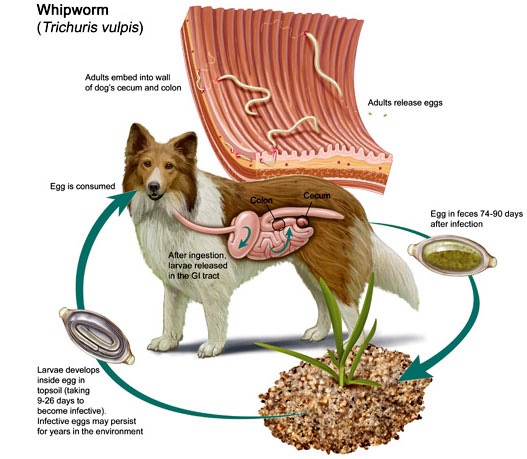
– For Toxocara canis: after the female lays her eggs, the eggs pass out
in the feces; after 5 days, the eggs hatch into larvae. When a dog swallows these larvae,
the larvae emerge and travel via the bloodstream to the liver, trachea, and finally to the intestine to develop
into adult worms. Some larvae, after entering the body, don’t return to the intestine but instead migrate
to muscles like the tongue or esophageal muscles to form cysts. Larvae can also
pass from a mother dog to her puppies through colostrum, or infect the placenta.
– For Toxascaris leonina: similar to T. canis, the eggs also
pass out in the feces; given suitable temperature and humidity, after 3 days they develop
into infective eggs. When a dog swallows them, the eggs hatch into larvae, and after
3–4 weeks they develop into adult worms.
3. Symptoms
– The animal becomes thin, grows slowly, and becomes anemic. Poor appetite, vomiting, constipation, followed by
diarrhea. A bloated belly occurs because food can’t pass through due to worms blocking the intestine,
and the coat becomes rough. Sometimes symptoms can resemble epilepsy or rabies.
4. Lesions
– Necropsy of the intestine will reveal adult worms attached beneath the intestinal
mucosa; large numbers can obstruct the intestine, preventing food from being digested and
causing bloating. Examining the tongue and esophageal muscles and squeezing them will produce a
popping sound as the worm cysts rupture.
5. Diagnosis
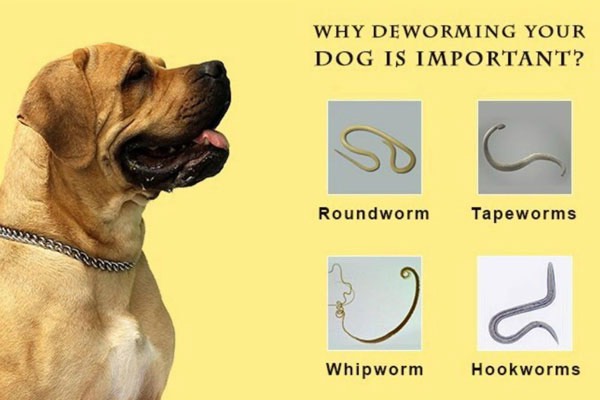
– For live dogs: fecal flotation testing to find roundworm
eggs. The eggs of the two species can be distinguished by their outer morphology, while
clinical symptoms should also be monitored to determine the severity of
the disease.
– For dogs that have died: necropsy of the intestine to look for worms under the intestinal mucosa, and
examination of the tongue and esophageal muscles to look for worm cysts.
6. Prevention

– Regularly disinfect your dog’s living environment.
– Dispose of dog feces cleanly; don’t let dogs come into contact with their own feces or that of other
dogs.
– Feed your dog safe, clean food and water. Don’t let them eat food that’s fallen on the ground.
– Avoid letting your dog rest in unsanitary areas or bathroom spots.
– Deworm your dog on a regular schedule, especially female dogs before giving birth, to
prevent transmission from mother to puppies.
Source: Veterinary Care – BTM Pet Shop
?Diagnosis and treatment for pets (24/7)
? Pet accessories supplied
? Pet hotel
? Pet grooming
? Grooming training for students
? 093 71 73 188
?? 135/31 Nguyễn Hữu Cảnh, Ward 22, Bình Thạnh, Ho Chi Minh City
BTM Pet Shop — Diagnosis and treatment for pets (24/7)
- ✂️ Pet grooming
- 🏨 Pet hotel
- 🎓 Grooming training for students
- 🛍️ Pet accessories supplied
- 📞 093 71 73 188
- 📍 135/31 Nguyễn Hữu Cảnh, Ward 22, Bình Thạnh, Ho Chi Minh City