
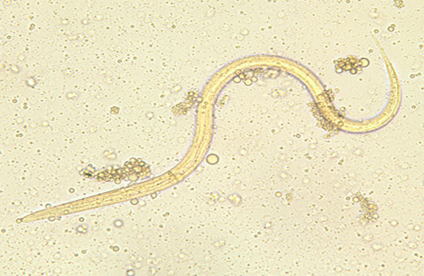
Intestinal Threadworm (Strongyloides stercoralis)
– Strongyloides spp threadworms infect dogs, cats, and humans. Dogs become infected by ingesting infective
larvae through their mother’s milk, or when larvae actively penetrate the dog’s skin.
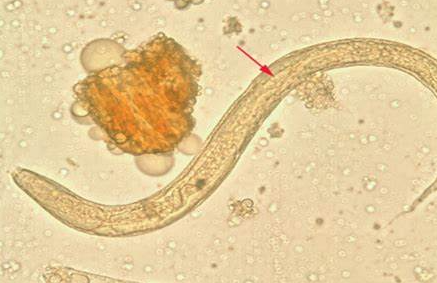
– Parasite: Strongyloides stercoralis (also called Strongyloides canis)
– Common name: Intestinal threadworm
– Host: dogs, humans, ± cats
– Incubation period: 6–10 days;
– Site of adult worms: small intestine
– Distribution: worldwide
– Route of transmission: through the skin, through mother’s milk, and autoinfection
– Transmission to humans: Yes
– Distribution
Worldwide.
– Clinical signs
Most dogs show no symptoms, developing strong immunity to the
infection and preventing larval shedding within the first 8–12 weeks of life. In puppies, it can lead to a
mild, self-limiting watery or mucoid diarrhea. In severe infections, a
gradual decline in health and signs of bronchopneumonia can occur due to migrating autoinfective larvae.
Paw dermatitis can be caused by larvae penetrating the skin.

– Treatment
Using a single off-label dose of ivermectin 200 μg/kg, or fenbendazole 50 mg/kg once daily
for 5 consecutive days, is effective at eliminating adult worms. Retest the stool twice, at
2 and 4 weeks after treatment, and monthly thereafter, over a total period of 6 months. In some
cases, retreatment may be necessary.
– Control
In areas with a high prevalence of Strongyloides, consider testing dogs before starting any immunosuppressive
therapy, particularly corticosteroids. Latent intestinal worm infection can reactivate when the
host becomes immunocompromised (e.g. due to medication, treatment, or neoplasia), triggering autoinfective
larval production that can cause life-threatening disseminated infection. Infected dogs should be isolated from
other animals. For more control options, refer to the General Notes & Recommendations
section.

– Public health considerations
In humans, clinical signs of S. stercoralis infection can range from asymptomatic to
causing digestive upset (e.g. abdominal pain, diarrhea) and coughing. Larvae penetrating the skin can
also cause fast-migrating cutaneous larva currens. In immunocompromised people, autoinfection can
lead to hyperinfection syndrome, disseminated strongyloidiasis, and sepsis, which can be fatal.
? Pet accessories supplied
? Pet hotel
? Pet grooming
? Grooming training for students
☎️093 71 73 188
?? 135/31 Nguyễn Hữu Cảnh, Ward 22, Bình Thạnh, Ho Chi Minh City