
HOW TO TREAT FLEAS AND TICKS ON CATS
Fleas and ticks on cats are always a top concern for pet owners, since when these parasites take hold, they don’t just make a cat “itchy” and prone to scratching — they can also lead to skin conditions like mange, fungal infections, skin infections, and general poor health, along with bloodborne diseases that can have serious, hard-to-predict consequences.
Fleas and ticks can also cause a lot of trouble for your family, especially if you have small children. Fleas and ticks crawling onto arms, legs, and ears and biting a child’s skin can cause chicken pox-like rashes or fever.
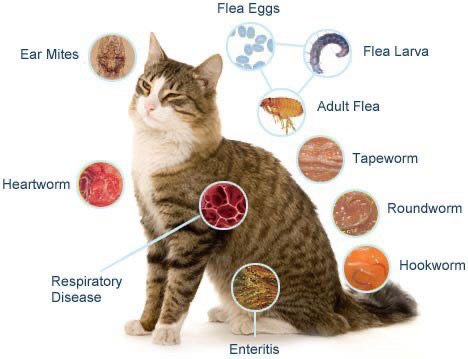
Signs your cat has ear mites
A cat with ear mites will typically show a few characteristic symptoms:
Excessive ear scratching
Frequent head shaking, showing signs of discomfort.
A strong odor from the ears
A small amount of dark discharge from inside the cat’s ears.
Signs your cat has fleas
The cat scratches a lot, seems restless, and can’t settle down
Unusual signs in the cat’s coat (hair loss).

Causes of fleas and ticks in cats
1. Direct contact with fleas or ticks
In everyday life, your cat may accidentally step on a flea or tick, or brush up against an area where fleas and ticks are present. Cats can also pick up fleas and ticks simply from being in an environment where they’re present.
2. Contact with other infested cats or dogs
A very common reason cats get fleas is that while playing with other pets, fleas jump over and settle onto their fur.
3. An unsanitary living environment
When the living environment is unsanitary, fleas and ticks can burrow into cracks and crevices and lay eggs there, just waiting for your cat to come along and become a host. That’s also why many people find fleas and ticks come back quickly even after treating their cat.

Effective ways to treat fleas and ticks on cats
1. Use a flea-and-tick spray for cats
Frontline Spray 100ml for dogs and cats is an anti-parasitic spray applied topically for both dogs and cats.
Frontline is used to treat and prevent flea infestations (Ctenocephalides spp) and ticks (Rhipicephalus spp, Dermacentor spp, Ixodes spp) in dogs and cats. It treats and controls flea allergy dermatitis in dogs, and helps prevent fleas by stopping the development of flea eggs, larvae, and pupae for six weeks after application. It also prevents and treats lice infestations of the head in dogs and cats.
Frontline Spray 100ml is a treatment that can kill fleas and ticks on contact once applied to your pet’s skin where the parasites live. After application, Frontline Spray 100ml doesn’t get absorbed into the bloodstream — instead, it acts on the sebaceous glands of a dog or cat’s skin (a thin layer on the surface), which is how the medication ends up stored in these glands.
Frontline stays active on a cat’s skin for weeks after application and resists rain, bathing, and shampoo. Frontline remains effective even after bathing your cat. Fleas and ticks are killed when they come into contact with the insecticidal/acaricidal molecules on your cat’s skin.
2. Use a spot-on treatment for cats
Spot-on treatments tend to be more popular thanks to their fast results. Frontline Plus flea medication for cats works two ways: the product kills existing ticks and fleas, while also preventing eggs and larvae from developing on your cat’s body — keeping your pet consistently protected from these unpleasant parasites.
Simply remove the tube from its packaging. Hold the tube upright and snap off the tip. Then place the tip of the tube against your cat’s skin, between the shoulder blades. Gently squeeze the tube to dispense all of the liquid along a line on the cat’s skin. Be sure to apply the medication directly onto the skin rather than onto the fur, so it can be properly absorbed.
This medication works by paralyzing the nervous system of fleas and ticks, killing off these parasites within 24 hours. It also helps prevent conditions like dermatitis and further parasite eggs.
The product’s main active ingredients are fipronil and methoprene. This combination effectively repels fleas and ticks, and also inhibits the growth and maturation of their larvae and eggs.

3. Use a flea collar for cats
Flea collars for cats lead the pack when it comes to using a strong yet non-toxic pest-control formula. Made with natural ingredients and worn around the cat’s neck, the collar releases its active ingredients directly, quickly killing fleas, lice, mites, and ticks on the cat’s body.
At the same time, specialized technology can gradually destroy pest eggs for long-lasting effectiveness. Its two-layer pest-elimination function creates a solid barrier that protects your pet’s health.
It’s an effective way to prevent your pet from catching infectious diseases, and it lasts a full 4 months. The product also looks good, so your cat can wear it as usual while playing outside.
Instructions for using a Fledom Virbac anti-flea collar
– Fasten the collar around your cat’s neck, adjusting it for a comfortable fit (leave about two fingers’ width of space between the collar and your cat’s neck; as a growing kitten’s neck gets bigger, you’ll want to loosen the collar accordingly and trim off any excess length).
– For continuous protection, it’s recommended to replace the collar every 2–3 months. The collar should be worn consistently and isn’t affected by water or humidity.
However, it should be removed each time you bathe your cat, and put back on once the fur and skin are dry.
Notes on using anti-flea collars:
– Keep the collar in its sealed packaging until use
– Don’t let your pet chew on the collar
– Keep it out of children’s reach
– Wash your hands after handling it

4. Treat fleas on cats with tomato juice
Blend 5 tomatoes to extract the juice, then put it in a spray bottle and spray it generously on your cat, especially in areas where fleas and ticks tend to hide. Tomato juice contains compounds that can treat fleas and ticks quite effectively.
5. Treat fleas and ticks on cats with a homemade rinse
Boil 2 cups of water, and finely chop 2 lemons, an orange, and a grapefruit. Add them to the boiling water for about a minute, then reduce to a simmer for about an hour. Strain out the citrus pulp, let the liquid cool, pour it into a spray bottle, and spray it on your cat, especially anywhere you suspect fleas or ticks. This is a simple yet very effective way to get rid of fleas and ticks on your cat.
6. Treat fleas and ticks on cats with borax powder
Apply borax powder to your cat’s fur and skin about 10–15 minutes before bathing. The powder will kill or numb the fleas and ticks so they can no longer cling tightly to the cat’s skin. Combined with bathing, this will get rid of fleas and ticks much faster. After doing this for a while, your cat will be free of these unpleasant parasites. That’s why this is a go-to remedy for fleas and ticks on cats that many people trust.
7. Use camphor
Buy about 3 camphor balls: place 2 underneath your cat’s sleeping spot, and crush the third one to apply on your cat’s body, then let your cat sunbathe for about 10–15 minutes.
8. Other methods
Another method many cat owners trust is a veterinary injection. However, this method requires the help of a veterinarian.